When people talk about online advertising, you’ll often hear the terms “PPC” and “Google Ads” used in the same conversation.
Someone might say, “We should start PPC for our business,” while another person suggests, “Let’s run Google Ads.”
Are they talking about the same thing?
Not exactly.
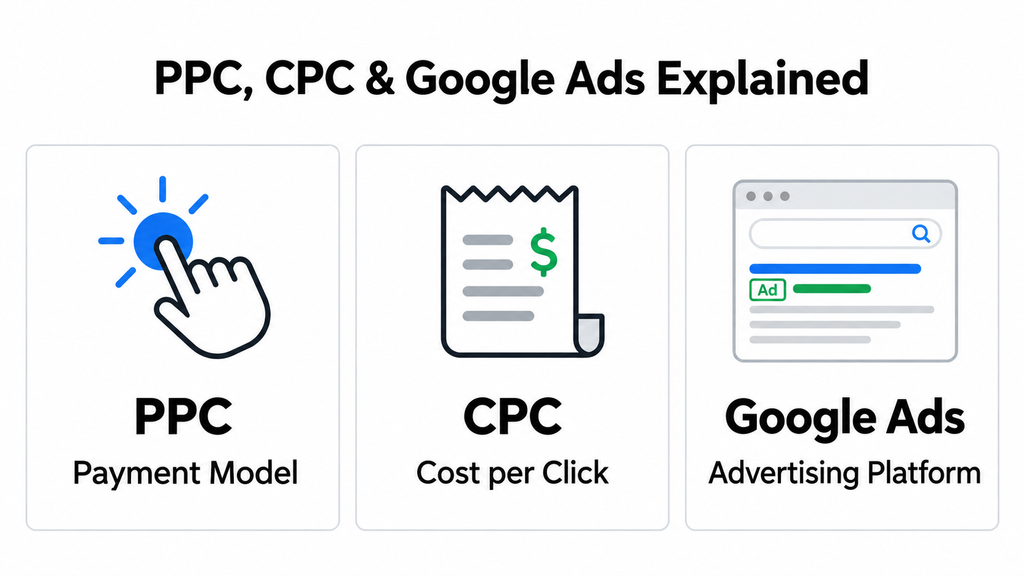
PPC is a way of paying for advertisements, while Google Ads is an advertising platform where businesses can run different types of campaigns, including PPC.
The two are closely connected, which is why people sometimes use the terms interchangeably. But understanding the difference matters when you’re deciding where to spend your advertising budget.
Whether you run an online store, manage a service business, or simply want more customers through your website, knowing how PPC and Google Ads work can help you make better marketing decisions.
Let’s discuss both, step by step.
What Is PPC Advertising?
PPC stands for Pay-Per-Click.
It’s an online advertising model where an advertiser pays when someone clicks on their ad.
Imagine you run an online store selling smartphones.
You create an advertisement promoting your latest collection. The ad appears in front of potential customers, and some of them click to visit your website.
With a pay-per-click model, you pay for those clicks rather than simply for every time the advertisement appears.
That’s PPC in its simplest form.
But there’s something worth remembering: paying for clicks doesn’t mean you’re paying for customers.
Someone might click your ad, browse a few products, and leave without purchasing anything.
This is why a successful PPC campaign needs more than traffic. It needs relevant targeting, useful landing pages, and a clear understanding of what you want visitors to do.
How Does PPC Work?
Although the process varies between advertising platforms, a typical PPC campaign involves a few important steps:
- Choosing your audience or keywords: Decide who you want to reach or which searches are relevant to your business.
- Creating advertisements: Write engaging ad copy or use relevant images and videos.
- Setting a budget: Determine how much you’re comfortable spending.
- Managing bids: Depending on the platform and campaign type, decide how your bids should be handled.
- Tracking performance: Monitor clicks, enquiries, purchases, and advertising costs.
For example, a business selling headphones might target searches related to “wireless headphones” or “Bluetooth headphones online.”
If its advertisement appears and someone clicks it, the advertiser may be charged for that click.
The important part comes afterward.
Did the visitor find the product they wanted? Was the price competitive? Did they place an order?
These questions tell you much more about your campaign than the number of clicks alone.
Where Is PPC Advertising Used?
PPC isn’t limited to one website or advertising platform.
Businesses can use click-based advertising through several channels, including:
- Search engines: Google Ads and Microsoft Advertising.
- Social media: Platforms such as Facebook, Instagram, and LinkedIn offer advertising options that can involve click-based costs.
- Online marketplaces: Advertising solutions available through platforms such as Amazon.
- Other digital advertising networks: Depending on the available campaign formats and billing options.
However, not every advertisement on these platforms uses a PPC payment model. Some campaigns charge for impressions, views, or other interactions.
That brings us to the important difference: PPC describes a payment model, not a particular advertising company.
What Is Google Ads?
Google Ads is Google’s online advertising platform.
It allows businesses to advertise across Google Search, YouTube, and other advertising placements within Google’s network.
You’ve probably come across Google Ads without paying much attention to them.
For example, search for “best smartphones under 50000” on Google.
You may see sponsored results from mobile retailers. These advertisements can appear when businesses run relevant Google Search campaigns.
But Google Ads isn’t limited to the sponsored text results you see on a search page.
It offers several campaign types designed for different marketing goals.
Types of Campaigns Available in Google Ads
1. Search Ads
These are advertisements that can appear alongside Google Search results.
For example, if someone searches for “emergency plumber near me,” a plumbing company might want its advertisement to appear because that person is already looking for a service.
Search Ads are particularly useful when customers are actively searching for what you offer.
2. Shopping Ads
Shopping Ads help retailers promote products with information such as images, prices, and store details.
For an online electronics store, showing the product image and price can help customers compare available options before visiting the website.
3. Display Ads
Display advertising uses visual advertisements across eligible websites, apps, and other placements.
These ads can be useful when you want to introduce your brand to a wider audience or reconnect with people who have previously interacted with your business.
4. Video Ads
Google Ads also allows businesses to promote video content through YouTube.
Video advertising can be valuable when a product needs a demonstration or when a brand wants to tell its story visually.
5. Performance Max
Performance Max is a goal-based campaign type that can advertise across multiple Google channels through a single campaign.
It uses automation to help businesses work toward goals such as online sales or leads.
6. Demand Gen
Demand Gen campaigns help businesses reach potential customers through visually engaging advertisements across supported Google placements.
They can be particularly useful when you want people to discover a product before they begin actively searching for it.
If you’re new to the platform, our Google Ads beginner’s guide explains some of the basics in more detail.
Does Every Google Ads Campaign Use PPC?
No.
This is one of the reasons Google Ads and PPC shouldn’t be treated as identical terms.
Many Google Search campaigns use a cost-per-click model, but Google Ads also supports other ways of bidding and paying for advertising.
Depending on the campaign, advertisers may focus on:
- Clicks.
- Impressions.
- Video views or interactions.
- Conversions and conversion value.
So, when someone says they’re running Google Ads, you can’t automatically assume they’re paying for every click.
You need to know which campaign they’re running and how its bidding and billing work.
PPC vs Google Ads: What’s the Actual Difference?
Let’s make the distinction easier.
PPC is the payment model. Google Ads is the advertising platform.
Here’s what that means in practice:
- PPC: Describes advertising where you pay based on clicks.
- Google Ads: Provides the tools to create, manage, and measure advertising campaigns.
- PPC campaigns: Can run on different advertising platforms.
- Google Ads campaigns: Can use different campaign types and bidding approaches, not just traditional PPC.
Think of it this way.
An online store is where you sell your products. Cash on delivery is one way a customer can pay.
The store and the payment method are connected, but they aren’t the same thing.
Similarly, Google Ads is the platform, while PPC is one of the advertising payment models available to businesses.
Once you understand that, the difference between PPC and Google Ads becomes much easier to remember.
PPC vs CPC: Are They Different Too?
Another term you’ll often hear alongside PPC is CPC.
These terms are related, but they mean different things.
PPC (Pay-Per-Click) describes the advertising model.
CPC (Cost-Per-Click) tells you how much an individual click costs.
For example, suppose you’re running a Google Search campaign with a maximum CPC bid of PKR 20.
If a particular click costs you PKR 15, then your actual CPC for that click is PKR 15.
PPC tells you how the advertising model works. CPC helps you measure its cost.
And if you’re analysing campaign performance, CPC becomes an important metric.
A low CPC might allow you to attract more visitors within your budget. But lower costs aren’t always better if those visitors aren’t interested in buying.
Sometimes, paying more for a highly relevant click can be worthwhile.
What matters is whether the advertising is helping your business achieve its goals.
How Does Google Ads Decide Which Advertisements to Show?
Here’s something many business owners find surprising.
Google doesn’t simply give the best advertising position to whoever is willing to pay the most.
Instead, Google Search Ads uses an auction that evaluates eligible advertisements when someone performs a search.
Different factors help determine whether an advertisement appears and where it may be placed.
Factors That Influence Google Ads Placement
1. Your Bid
This is related to how much you’re willing to pay or the bidding goal you’ve selected.
But a higher bid alone doesn’t guarantee the top position.
2. Ad Relevance
Does your advertisement actually match what someone is searching for?
If a customer searches for “buy running shoes,” an ad promoting running shoes is likely to be more relevant than one advertising unrelated clothing products.
3. Landing Page Experience
What happens after someone clicks?
Your landing page should be relevant, useful, and easy to navigate.
A misleading ad that sends visitors to an unrelated page isn’t a good experience.
4. Competition and Search Context
Google also considers factors related to the auction, such as competing advertisements, the search being made, the person’s location, and the device they’re using.
5. Ad Assets
Additional information, such as sitelinks and other available ad assets, can also influence how advertisements perform in the auction.
Where Does Quality Score Fit In?
If you’ve worked with Google Ads before, you’ve probably heard about Quality Score.
It’s a diagnostic metric reported on a scale of 1 to 10 for eligible Search keywords.
It helps advertisers assess areas such as expected click-through rate, ad relevance, and landing page experience.
However, the Quality Score number itself is not a direct input into Google’s ad auction.
Think of it as a tool for understanding where your advertising experience may need improvement.
You shouldn’t focus only on increasing the score. You should focus on making the ads and landing pages more relevant to potential customers.
How Much Do PPC and Google Ads Cost?
There’s no single answer to this question.
The cost of PPC advertising depends on the platform, audience, competition, and campaign settings.
Within Google Ads, factors such as keywords, location, industry, and ad quality can influence costs.
For example, a business targeting highly competitive financial services searches might face different advertising costs from an online store promoting everyday accessories.
But here’s where business owners sometimes get confused.
Spending more doesn’t automatically mean earning more.
Suppose you spend PKR 10,000 on Google Ads and your campaign generates PKR 30,000 in attributed sales.
Your return on ad spend (ROAS) would be 3x.
That means you generated three rupees in recorded sales revenue for every rupee spent on ads.
Sounds good, right?
Possibly. But you still need to consider product costs, delivery charges, payment fees, and other business expenses before deciding whether the campaign was profitable.
This is also why the common claim that every business earns a particular percentage return from Google Ads shouldn’t be treated as a guarantee.
Some campaigns perform well. Others need considerable improvement. Some simply don’t generate a positive return.
For more detail, read our Google Ads cost, CPC, and ROI guide.
Google Ads vs Social Media PPC: Which Is Better?
Let’s suppose you’re selling wireless headphones.
You could advertise them through Google Ads or through a social media platform such as Instagram.
Both could bring visitors to your website, but the way people discover your advertisements may be different.
With Google Search Ads, you’re often reaching someone who’s already looking for a product.
A person searching for “buy wireless headphones online” has expressed a clear interest.
With social media advertising, you may reach people based on audience information, interests, and behaviour, even if they aren’t actively searching for headphones at that moment.
That can be useful for introducing a product or encouraging people to consider something new.
Of course, the distinction isn’t absolute. Google Ads also offers visual, audience-focused campaigns, while social platforms can support conversion-focused advertising.
The better platform depends on your business and what you’re trying to accomplish.
If your main goal is to capture existing search demand, Google Search Ads may be a sensible starting point.
If you’re launching a new product that people don’t yet know about, visual advertising may be useful for introducing it.
And if your budget allows, the two approaches can work together.
Do PPC Advertising and SEO Work Together?
Yes, and understanding their relationship can help you plan a more balanced marketing strategy.
Search Engine Optimization (SEO) focuses on improving your visibility in organic search results.
PPC focuses on paid advertising.
Paying for Google Ads doesn’t directly improve your website’s organic rankings. Google treats its advertising and organic search systems separately.
Still, the two strategies can support each other.
Here’s how:
- Keyword insights: Advertising performance can help you identify searches associated with enquiries or purchases.
- Short-term visibility: Paid campaigns can help reach potential customers while your SEO work develops.
- Landing page improvements: A useful, well-organized landing page can benefit visitors arriving through both paid and organic search.
- Different customer journeys: Some people discover businesses through an advertisement, while others find them through organic search.
For example, a new online store might run Google Ads for products that are available to purchase immediately.
At the same time, it could develop useful category pages, buying guides, and product content to improve its organic visibility.
Instead of treating PPC and SEO as competitors, the business uses each for a different purpose.
We’ve explained this distinction further in our article on SEO vs SEM and how the two strategies differ.
How Do You Choose the Right Advertising Platform?
Before choosing any advertising platform, ask yourself one simple question:
What do I actually want my advertising to achieve?
More visitors? More enquiries? More purchases? Or simply more people becoming familiar with your brand?
The answer should guide your decision.
For example:
- If you need enquiries for a service: Google Search Ads may help you reach people searching for that service.
- If you sell products online: Shopping campaigns, Performance Max, or relevant Search campaigns may be worth evaluating.
- If you want to introduce a new brand: Visual and video advertising can help communicate what makes it different.
- If you’re testing a new product: A controlled campaign can help you understand demand before committing a larger budget.
- If you have a limited budget: Start with a clearly defined goal and a manageable campaign rather than spreading your spending across too many channels.
And don’t judge success by clicks alone.
A campaign bringing 1,000 visitors isn’t necessarily better than one bringing 100 visitors.
If the smaller campaign attracts genuine buyers while the larger one brings irrelevant traffic, the numbers tell a very different story.
This is why conversion tracking, search term reviews, and ongoing campaign improvements matter.
At Search Formals, our approach to Google Ads focuses on connecting campaign decisions with business goals, whether that’s generating relevant enquiries or improving online sales.
Final Thoughts: Is PPC the Same as Google Ads?
So, are PPC and Google Ads the same?
No. PPC is a payment model, and Google Ads is an advertising platform.
Google Ads allows businesses to run PPC campaigns, but it also supports other advertising formats and bidding approaches.
Similarly, PPC isn’t limited to Google. Different advertising platforms can offer click-based campaigns.
Understanding this difference helps you move beyond simply choosing a platform.
You can start thinking about the questions that matter more:
- Who are you trying to reach?
- What action do you want them to take?
- How much can you afford to spend?
- How will you measure whether the campaign is working?
Because running ads is relatively easy to begin.
Running advertisements that bring the right people to your business, and making sensible decisions with your budget, takes a little more thought.